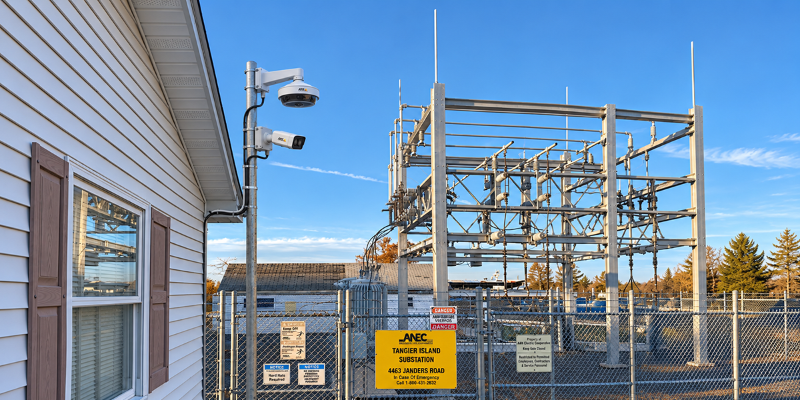
A&N Electric Cooperative is using artificial intelligence (AI)-enabled monitoring to identify equipment problems earlier, speed outage response and give operators actionable information through the systems they already use.
The value became clear when thermal cameras detected an abnormal heat pattern inside a substation, narrowed the affected area and sent an alarm through the cooperative’s supervisory control and data acquisition (SCADA) system. Operators used the thermal imagery to direct a technician to the equipment. The technician confirmed a stuck cooling-fan motor and corrected it before it damaged the transformer or interrupted service.
For Kevin Harmon, A&N’s director of operations, the incident shows why the cooperative has steadily expanded AI-enabled monitoring across its substations since 2024.
Based in Tasley, Virginia, A&N serves more than 35,000 meters on Virginia’s Eastern Shore and Smith Island in Maryland. The cooperative began deploying the Smart Surveillance and Asset Monitoring (SSAM) platform in 2024. Fourteen of its 18 substations are equipped and the remaining four are scheduled for deployment in 2027.
Working with SAM Analytic Solutions, A&N has developed a platform that combines thermal and optical cameras, local edge analytics and integration with its existing SCADA system. At some locations, panoramic cameras give operators a 360-degree view of the substation, while defined thermal zones continuously monitor critical equipment for abnormal heat patterns. The system can also detect intrusions and other unexpected activity.
“The big benefit is finding problems before they actually become outages or major problems,” Harmon said.
When an alarm occurs, employees can pinpoint the issue and send the responding technician thermal images, video clips and other information before the technician reaches the site.
That situational awareness also can shorten outage duration.
After a bird caused a feeder outage affecting more than 2,000 members, the system captured the event and gave operators a video clip. Instead of beginning an extended line patrol to identify the cause, employees knew the likely cause and location before the troubleshooter arrived. A&N restored the circuit in approximately 30 minutes. Harmon estimated the work could have taken more than an hour without the additional information.
“That’s the value it’s bringing,” Harmon said. “We were able to identify the fault faster, respond quicker and get the members back on much quicker.”
We were able to identify the fault faster, respond quicker and get the members back on much quicker.

A&N also designed the system to meet a critical cybersecurity requirement: Analytics and event processing remain local. The cyber-segmented architecture uses edge processing instead of cloud connectivity, and A&N selects camera hardware that complies with applicable National Defense Authorization Act Section 889 requirements.
“It doesn’t touch the internet,” Harmon said. “Everything is localized to our machines.”
A&N also did not want operators to monitor another standalone application. SSAM alarms are mapped into the SCADA environment employees already use, allowing thermal, security and system health events to appear within established workflows.
As employees gained experience, A&N and SAM refined camera placement, thermal zones and detection sensitivity. They also added operator-controlled alarm suppression during planned maintenance so authorized work would not generate unnecessary alarms. Those lessons show that successful deployment requires site-specific commissioning rather than identical camera settings at every location.
A&N is beginning to use the technology beyond substations. The cooperative recently installed monitoring equipment near a causeway serving an island where coastal storms can create overwash and close access. During a September nor’easter, employees watched conditions deteriorate and began staging crews before receiving formal notice that the roadway would close.
For other cooperatives considering AI-enabled monitoring, Harmon’s advice is straightforward: “Try it.”
The goal, he said, is not simply to add another technology platform. It is to make better use of the cameras, communications systems and SCADA infrastructure a cooperative already has and give employees actionable information when it matters.