economy
November 16, 2026
Eyes on the Economy: Productivity, Hiring, Inflation

Labor Productivity Surges in Third Quarter
U.S. labor productivity increased at a 3.6% annualized rate in the third quarter of 2026, exceeding forecasts of 2.8% and accelerating from an upwardly revised 2.1% in the second quarter. Productivity, which measures output per hour worked, rose 2.1% from a year earlier. Stronger efficiency helped reduce unit labor costs by 0.7%, the first quarterly decline since the second quarter of 2025. Economists had expected a 0.6% increase. Labor costs remained 2.4% higher than a year earlier.
The figures reinforced evidence that labor costs were not driving inflation, while economists and policymakers continued watching whether substantial investment in artificial intelligence would deliver sustained productivity gains.
October Hiring Beats Expectations
The U.S. economy added 165,000 jobs in October 2026, exceeding expectations of 65,000 and accelerating from September’s upwardly revised gain of 60,000. Hiring also surpassed the average monthly increase of 48,000 recorded over the preceding year. August and September payroll gains were revised higher by a combined 84,000. Professional and business services led job growth, adding 70,000 positions, followed by healthcare with 42,000 and transportation and warehousing with 25,000. Manufacturing added 19,000 jobs, bringing its cumulative increase since December 2025 to 101,000. Employment changed little across most other major industries, including construction, retail trade, financial activities, leisure and hospitality, and government.
The unemployment rate declined to 4.1% from 4.2%, slightly below expectations. Household survey employment increased by 463,000 to 163.62 million, while the number of unemployed fell by 41,000 to 7.07 million. The labor force expanded by 421,000—lifting participation to 61.9% from 61.8%. The employment-to-population ratio reached 59.3%, its highest level since February. Despite stronger headline figures, broader labor market measures suggested some weakness. The U-6 unemployment rate, which includes underemployed and marginally attached workers, rose to 7.9% from 7.6%, indicating that labor market improvement remained uneven.
October Inflation Accelerates as Housing and Food Costs Rise
Consumer prices increased more than expected in October, underscoring persistent inflation pressures and complicating the Federal Reserve’s policy outlook. The consumer price index rose 0.4% on a seasonally adjusted basis, exceeding economists’ forecast of 0.3%, although slowing from September’s 0.6% increase. Excluding food and energy, core prices advanced 0.3%, above the anticipated 0.2% gain.
Housing remained a major contributor. Shelter costs increased 0.3%, accounting for more than 30% of the overall monthly rise. Food prices climbed 0.5% after remaining unchanged in September, with grocery prices increasing 0.4% and dining out becoming 0.5% more expensive. Energy prices rose 0.7%, a substantial moderation from September’s 5.2% jump. Gasoline increased 1%, while electricity prices advanced 0.9%. Underlying inflation remained steady, with core prices posting their third consecutive monthly increase of 0.3%. Recreation, medical care, vehicle insurance and household furnishings became more expensive. Used vehicles and communication services provided some relief, recording price declines. Together, the figures showed continued increases across several major household spending categories.
The government did not publish an overall annual inflation rate because the October 2025 federal government shutdown interrupted data collection, leaving insufficient information for a comparable year-over-year calculation.
Core Inflation 3-Month Annualized % Change
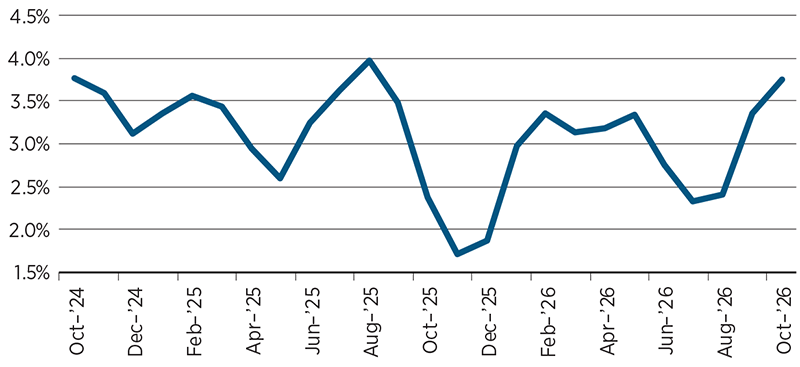
Source: Federal Reserve of St. Louis.
Recent Economic Releases
| Indicator | Prior period | Current period (forecast) | Current period (actual) |
|---|---|---|---|
| Nonfarm Labor Productivity (Q3 2026)(QoQ) | 2.1% | 2.8% | 3.6% |
| Nonfarm Payrolls (Oct.) | 60K | 65K | 165K |
| Unemployment Rate (Oct.) | 4.2% | 4.2% | 4.1% |
| Consumer Price Index (Oct.)(MoM) | 0.6% | 0.3% | 0.4% |
Key Interest Rates
| 11/9/26 | 11/2/26 | Change | |
|---|---|---|---|
| Fed Funds | 4.00% | 4.00% | --- |
| 2-yr. UST | 4.55% | 4.58% | (0.03) |
| 5-yr. UST | 4.66% | 4.69% | (0.03) |
| 10-yr. UST | 4.86% | 4.89% | (0.03) |
| 30-yr. UST | 5.26% | 5.27% | (0.01) |
Rate Forecast — Futures Market
| 4Q26 | 1Q27 | 2Q27 | 3Q27 | |
|---|---|---|---|---|
| 4.25% | 4.75% | 4.75% | 4.75% | |
| 4.71% | 4.66% | 4.55% | 4.42% | |
| 4.88% | 4.82% | 4.72% | 4.61% | |
| 5.10% | 5.02% | 4.92% | 4.82% | |
| 5.46% | 5.40% | 5.31% | 5.22% |